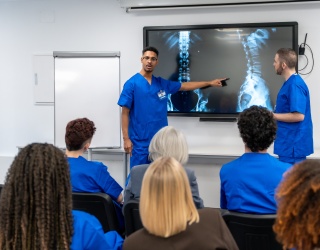
At ECR 2026, a special focus session examined an uncomfortable but increasingly relevant question: what happens when disaster strikes the radiology department itself? From earthquakes and mass casualty events to cyberattacks and war, speakers shared first-hand experiences highlighting radiology’s central role in crisis response—and the urgent need for preparedness.
When routine radiology becomes disaster response
Mass casualty events fundamentally change the way radiology operates. Instead of the usual patient-centered diagnostic workflow, departments must switch to rapid triage and population-level decision-making.
As Dr. Elizabeth Dick, Consultant Radiologist and Professor of Practice at the Imperial College London (UK), explained, the goal in these scenarios shifts dramatically: “What we're doing is we're delivering minimal acceptable care or damage control care to the whole population.”
Radiology becomes a potential bottleneck in emergency pathways, making it essential to streamline imaging and reporting. In practice, this means prioritizing speed over completeness: use X-ray instead of CT where possible, produce short, rapid reports, and ensure continuous communication across teams.
Equally critical is anticipating prolonged demand. Patients may return repeatedly for imaging in the hours and days following the initial event, requiring departments to plan staffing beyond the immediate surge.
Another key lesson is adaptability. Information during disasters changes rapidly, and radiologists may receive updates through news alerts rather than official hospital channels. As Dick warned, “Expect that it will be chaotic and fast changing.”
Earthquake response: imaging without infrastructure
Dr. Nursel Yurttutan, Professor of Radiology at Kahramanmaraş Sütçüimam University (Turkey), described the devastating earthquakes that struck the country in 2023 and their impact on radiology services. Hospitals were overwhelmed within hours, while staff were simultaneously coping with personal loss and safety concerns.
Imaging resources became both scarce and essential. With limited power and damaged infrastructure, ultrasound, particularly FAST examinations emerged as the most practical modality for rapid triage. Radiologists often worked directly in emergency areas under difficult conditions.
Despite the chaos, imaging remained critical to clinical decisions. As Yurttutan noted, “Without imaging, triage would have been blind.”
Documentation also had to be improvised. With electronic systems down and many patients without identification, handwritten reports and descriptive notes attached to patients became the only viable solution.
The experience reinforced the importance of flexible skills across subspecialties. Yurttutan reflected: “We learned skills matter more than subspecialties.”
Radiology in wartime conditions
For Dr. Yurii Antonenko, Chief of the Department of Radiology at Kyiv City Clinical Hospital (Ukraine), war has turned radiology departments into frontline medical infrastructure. Hospitals themselves may become targets, forcing departments to rethink physical safety, workflow, and energy resilience.
His central message was clear: “Preparedness prevents chaos and enables stability.” Backup power systems, generator capacity, satellite internet and supply resilience are all essential to maintain imaging capability during infrastructure attacks. Staffing shortages caused by displacement or military conscription also require cross-training across imaging modalities.
Even diagnostic thinking must adapt. When CT access is limited, clinicians may rely more heavily on ultrasound, laboratory findings and clinical judgement.
Cyberattacks: the invisible disaster
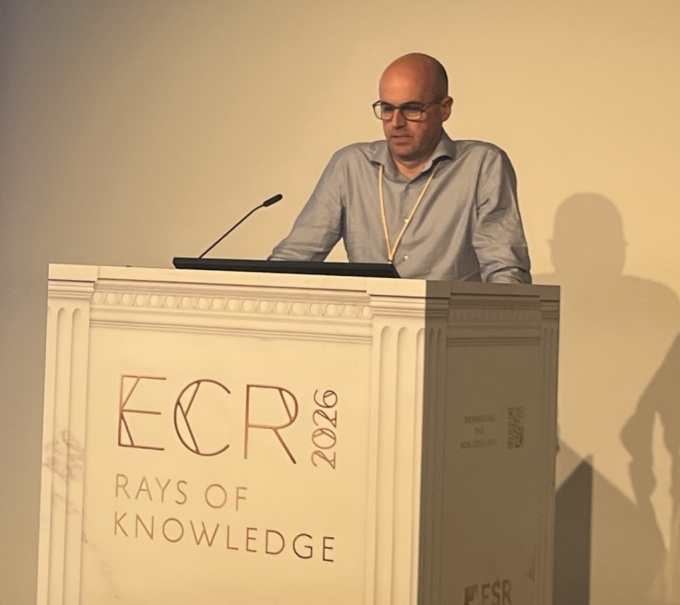
While physical disasters are dramatic, cyberattacks can cripple radiology just as effectively. Dr. Niall Sheehy, Consultant Radiologist at Beacon Hospital (Ireland), described the 2021 ransomware attack that shut down the Irish public health system.
Although scanners themselves continued functioning, the collapse of hospital networks meant no patient records, no orders, no PACS access and no communication systems.
Departments reverted to analogue workflows—paper requests, phone communication and even film printing. Productivity dropped dramatically, and full recovery took months.
The key takeaway: assuming systems will fail. Hospitals must maintain offline contingency plans, printed protocols and alternative communication methods.
Preparedness as the common thread
Across all scenarios—earthquake, war, cyberattack or mass casualty—the speakers shared a consistent conclusion: radiology must be embedded in disaster planning.
As Yurttutan summarized, “Disasters remind us that radiology is not only about imaging, it is about decisions, responsibility, and humanity.”
For radiology departments worldwide, the message from ECR 2026 was clear: preparation today determines resilience tomorrow.