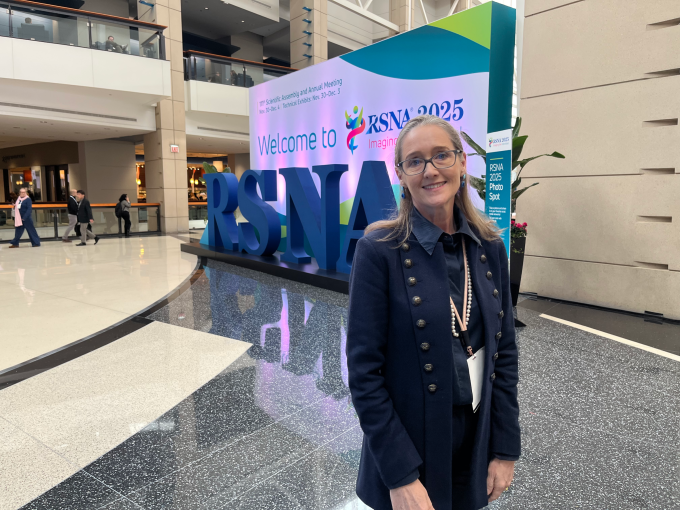
At RSNA 2025, leaders in gynecologic imaging presented new perspectives on how radiology can drive better outcomes for patients with ovarian cancer—a disease that remains difficult to detect early and challenging to treat effectively. Moderator Andrea Rockall, Clinical Chair of Radiology at Imperial College London and Chairperson of the ESR Board of Directors, emphasized the clinical urgency, stating, “We want what we're doing to really make a difference to patient care.”
She highlighted the sobering reality of outcomes in ovarian cancer, noting that Cancer Research UK data from 2013 to 2017 show a 35% survival rate for women who survive ovarian cancer for 10 or more years. With such persistently low long-term survival, she stressed the urgency of improved care, stating that “although we're not the highest in number, we are very deadly.”
Recognizing Malignancy in Adnexal Lesions
The session opened with Atul Shinagare’s practical, feature-based framework for evaluating incidental adnexal lesions across CT, ultrasound, and MRI. He began with a clear reminder of imaging's first responsibility: “First, don't miss cancer.”
Shinagare explained that certain imaging findings strongly suggest benignity, such as fat-containing lesions: “If you see something like this, you're done. You have the diagnosis.” In contrast, high-risk features include solid tissue, papillary projections, or peritoneal implants. Yet even these are not always straightforward on CT, a modality where subtle enhancing components may be easy to overlook and large lesions can pose similar pitfalls.
Across modalities, consistent principles emerged: cystic, unilocular, smooth-walled lesions without solid components tend to be benign; lesions with nodularity, complexity, or vascularity lean toward malignancy.
Imaging to Guide Surgical Decision-Making
In her recorded presentation, Yuliya Lakhman focused on how imaging supports decisions between upfront debulking surgery and neoadjuvant chemotherapy. She explained that the goal is always the same: “No residual disease at completion of surgery because of the greatest benefit to the patient.” When that is unattainable, futile surgery must be avoided: “What we want to avoid is futile laparotomy, that is residual disease greater than one centimeter.”
Lakhman outlined key red-flag anatomical regions—such as the mesenteric root, porta hepatis, pancreas, and upper abdomen—that influence operability. She emphasized the strategic importance of clearly flagging such findings: “It is important to use imaging to exclude alternative primary malignancy and to identify and highlight disease in challenging to resect or potentially unresectable locations because it helps to decide between upfront surgery or delayed surgery.”
While CT remains the standard, its limitations in the mesentery and bowel serosa are well recognized. MRI, particularly with diffusion-weighted imaging, shows promise: “Diffusion-weighted MRI has been shown to have superior accuracy for detecting unresectable distant metastasis, as well as diffuse serosal disease and mesenteric root involvement.”
Monitoring Recurrence and Treatment-Related Complications
Stefania Rizzo closed the session with a detailed examination of surveillance and complication assessment. She explained that surveillance relies on CT and, when CA-125 rises despite a negative CT, PET-CT. She also detailed complications after surgery, chemotherapy, anti-angiogenic therapy, and immunotherapy, underscoring radiology’s role in prompt detection. Her central message was clear: “An early detection and characterization of relapse and complications is critical for timely multidisciplinary management.”
Advancing Ovarian Cancer Care Through Precision Imaging
The RSNA 2025 session underscored radiology’s expanding impact across the ovarian cancer pathway—from differentiating benign from malignant lesions to optimizing surgical planning and identifying recurrence and complications. As Rockall noted, “We really have some work to do,” but advances in imaging offer powerful tools to improve outcomes for patients facing this aggressive disease.