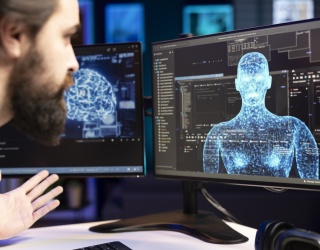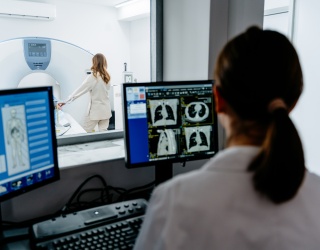
RSNA 2025 marked a clear inflection point for artificial intelligence in radiology. While prior years emphasized the algorithmic performance of point-of-care solutions, this year’s conversations reflected a more pragmatic shift. AI is now being evaluated by its ability to function within intelligent, integrated ecosystems that meaningfully improve radiologists’ daily work.
The focus has moved toward coherent, cloud-based, PACS-centered environments in which report drafting, secure vendor-neutral orchestration, and in-context intelligence operate together to reduce workload rather than add to it. Simply put, the goal is to make radiology more human and less hindered by technology.
Across exhibit halls and clinical discussions, one theme was unmistakable. Radiology no longer needs more tools; it needs fewer interruptions, fewer clicks, and fewer cognitive handoffs. Workflow efficiency has become the dominant lens through which AI is judged.
Research presented at RSNA highlighted the maturation of multimodal AI, including large language models, vision-language systems, and image-text architectures designed to streamline report drafting, summarization, and interpretation. More advanced, agentic models are beginning to outperform earlier iterations, while generative AI is increasingly positioned as an always-on, contextual GPS—supporting radiologists rather than distracting them.
Despite continued excitement around advanced scanners and new AI applications, RSNA 2025 made one point clear: adoption now hinges on operational impact inside the reading room and across the continuum of care. The question is no longer which component of the Quadruple—or even Quintuple—Aim[1] an AI tool supports, as the focus shifts toward optimizing overall health system performance.
To be viable, solutions must address all of it simultaneously, including clinical findings, downstream patient outcomes at a population level, radiologist well-being and tolerance for distraction, and institutional cost optimization—both financial and operational. The opportunity cost of time has simply become too large to ignore.

The End of “Best Algorithm Wins”
For much of the past decade, radiology AI was assessed primarily by diagnostic performance, with emphasis placed on sensitivity, specificity, validation datasets, and increasingly, AUC. That era is fading.
A model can demonstrate a perfect AUC or 99% accuracy and still be clinically and operationally irrelevant if it does not integrate seamlessly into workflow, influence prioritization, or reduce cognitive burden. Performance in isolation does not equate to impact.
Departments once ran vendor bake-offs to determine which algorithm could identify the most findings. Today’s reality is far more complex. Health systems are saturated with point solutions that are difficult to evaluate, integrate, and operationalize. Many organizations already run PACS, integrate AI marketplace platforms, maintain internal AI governance frameworks, and face internal decision-making latency that further slows adoption.
As a result, radiology leaders are asking different questions—questions centered less on technical excellence and more on operational value. They want to know whether a solution meaningfully reduces workload, simplifies how studies are read, and integrates naturally into existing workflows.
Academic radiologist and imaging leader Professor Alexander A. Bankier, Division Chief of Cardiothoracic Imaging at UMass Chan Medical School in Worcester, Massachusetts, captured this shift succinctly:
“Any platform that is not fully integrated into the workflow is of extremely limited use. Radiologists are getting tired of widgets and warnings that add clicks and stress instead of reducing them.”
Accuracy remains necessary, but it is no longer sufficient. AI must now justify itself operationally.
Workflow Integration Unlocks Decision-Making
One of the most consistent messages emerging from RSNA 2025 is that workflow integration—not algorithmic sophistication—is now the primary determinant of AI value. Radiologists are not resistant to AI; they are resistant to friction.
As Professor Bankier observed, AI may perform a task well in isolation, but if it requires excessive interaction, it quickly becomes more of a burden than a benefit. In some cases, AI actively stands in the way of workflow rather than facilitating it.
The divide between detection and impact remains critical. Many AI tools demonstrate strong diagnostic performance yet fail to change how work is actually done. Acute finding detection provides a clear illustration.
“If an algorithm detects pulmonary embolism but cannot push that study to the top of the worklist, it is only half useful,” Bankier explained. “The value is not in detection alone, but in changing how clinical work is prioritized.”
RSNA 2025 reinforced that AI must alter decision flow rather than simply generate additional information that radiologists must interpret and act upon manually. Successful solutions reshape and simplify worklists to guide attention toward the most acute and time-sensitive cases, reduce manual interactions to free up cognitive bandwidth for complex interpretation, and operate quietly in the background as intelligent assistants within secure, deeply integrated environments. Detection alone is insufficient if it does not translate into action.
Clinical Findings Alone Do Not Guarantee Better Outcomes
Another theme gaining traction is the growing recognition that algorithmic accuracy does not automatically lead to better clinical outcomes. Earlier diagnosis, while valuable, does not improve care if downstream bottlenecks remain unchanged.
Several AI platforms—including Aidoc, Viz.ai, and RapidAI—have begun addressing this gap by connecting care teams across specialties and departments, helping to unify the patient journey. In acute settings such as emergency-driven cases tied to major adverse cardiac events, stroke, hemorrhage, aneurysm, aortic rupture, deep vein thrombosis, and pulmonary embolism, value is realized only when all relevant teams are engaged immediately and in parallel.
As Bankier noted: “If you diagnose a critical finding earlier but the downstream bottlenecks remain unchanged, patient outcomes will not improve. Removing one isolated bottleneck in the system does not necessarily change the overall result.”
This mirrors lessons from earlier waves of imaging innovation. Technology must be paired with system-level readiness to translate speed into meaningful action.
Generative and Agentic AI: Automatic Drafting as a True Inflection Point
Where RSNA 2025 did signal a meaningful paradigm shift was in the emergence of generative and agentic AI systems capable of automatically drafting radiology reports within the workflow.
These systems represent a reallocation of radiologist attention. Repetitive tasks that software can reliably manage no longer need to consume clinical focus. Over time, radiologists may increasingly function as human orchestrators, overseeing multiple AI assistants that collectively optimize their work.
Unlike earlier decision-support tools, these systems are designed not merely to assist, but to offload cognitive and clerical work. When implemented responsibly, automatic drafting can reduce repetitive dictation, standardize report structure, accelerate turnaround times, and allow radiologists to focus on interpretation rather than transcription. This represents a fundamentally different value proposition—AI as a workload reducer rather than a workload multiplier.
At the same time, RSNA discussions reflected appropriate caution. Early deployments have shown that automated impressions must be carefully governed to avoid inaccuracies or misleading phrasing, reinforcing the need for human oversight and tight workflow integration.
As Bankier observed: “For the first time, people are seeing that AI can produce things that should not be there. The technology has limits, and those limits become visible when AI moves closer to report generation.”
The Road Ahead: Less Noise, More Intelligence—and the Right Business Model
RSNA 2025 made one conclusion unavoidable: radiology does not need more AI—it needs better AI. The next generation of successful solutions will integrate natively into PACS and EMR environments, reduce clicks, alerts, and cognitive burden, automate low-value tasks such as drafting and formatting, and enhance—rather than disrupt—the radiologist’s workflow.
Critically, even the most accurate model—regardless of its clinical performance—will fail without a business model that works for hospitals. If the economics do not support sustainable revenue generation, operational efficiency, or cost containment, clinical excellence alone will not drive adoption. In today’s environment, accuracy, workflow impact, and economic alignment are inseparable.

Safety, Governance, and Ethical Deployment Are Not Optional
As AI becomes more deeply embedded into clinical decision-making and report generation, safety, transparency, and ethical governance must be foundational rather than additive. Hospitals increasingly expect clear auditability, bias monitoring, human-in-the-loop controls, and alignment with internal AI governance and regulatory frameworks.
Trust will not be earned through performance metrics alone, but through responsible design. Systems must clearly communicate uncertainty, respect clinician authority, protect patient data, and behave predictably under real-world conditions. AI that reduces workload while preserving clinical judgment—and does so within a robust ethical and safety framework—will ultimately be the AI that scales.
The future of radiology AI will not be defined by how intelligent systems become, but by how much work they quietly remove—and how seamlessly they integrate into clinical reality, institutional economics, and a safely governed care environment.
In that sense, RSNA 2025 marked a decisive shift from innovation theater to operational accountability—and a meaningful step toward AI that finally delivers on its long-promised promise.
[1] The Quadruple Aim refers to improving patient experience, enhancing population health, reducing per-capita healthcare costs, and supporting clinician well-being; the Quintuple Aim extends this framework to include health equity.
Industry Expert Series written by Andjela Azabagic